
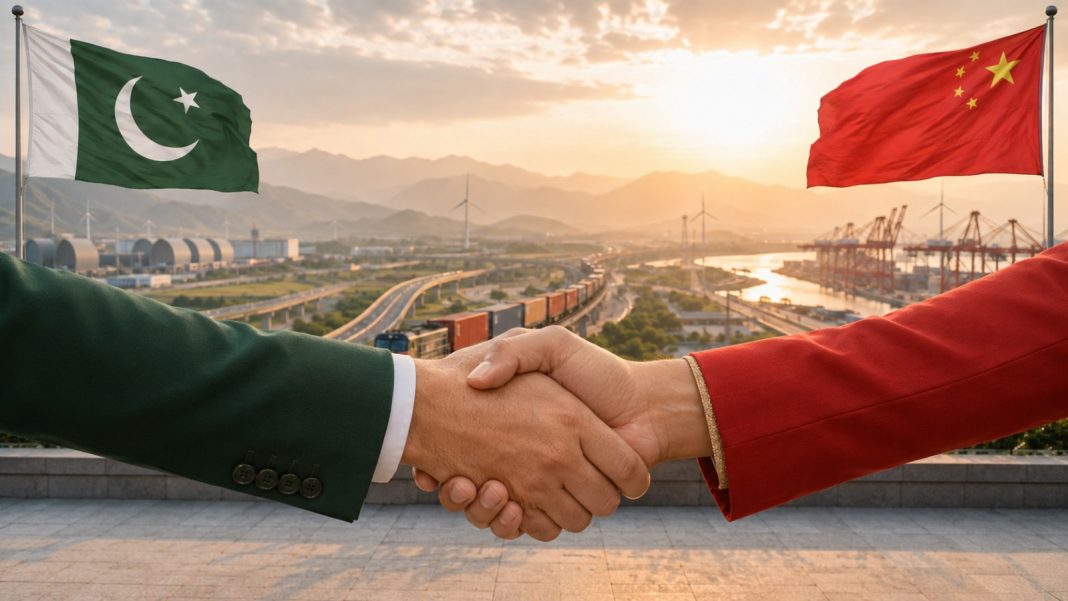
75 years is longer than most treaties survive. It is longer than most alliances last. It is longer than the political lifetime of any leader, any party, any government. In those seventy-five years, the Cold War began and ended. Empires dissolved. Economic orders rose, collapsed, and rose again. Partnerships were announced with great ceremony, and quietly abandoned.
And yet, through all of it, one relationship did not bend.
Here is a fact worth carrying home today: China has been Pakistan’s largest trading partner for twelve consecutive years. Not one good year. Not one favourable government. Twelve consecutive years, through elections, through economic crises, through a pandemic, through floods. That is what I mean when I say seventy-five years is not only a measure of time. It is a measure of trust. It is a measure of continuity. It is the record of a shared history that two nations chose to write together, and kept choosing, decade after decade, in good weather and in bad.
We gather today for two reasons, and they belong together more closely than it may first appear. We celebrate seventy-five years of diplomatic relations between Islamic Republic of Pakistan and the People’s Republic of China. And we inaugurate the Confucius Center at Minhaj University Lahore, established in collaboration with the Confucius Institute at the University of Agriculture Faisalabad and our Chinese partners, whose presence today honours this campus.
Today is not simply the opening of a new academic centre. It is the beginning of a new chapter in this University’s journey towards academic excellence, international engagement, and cultural understanding. One ceremony looks back at what two states have built. The other looks forward at what two people must now build, and the second task is the natural continuation of the first. A friendship that began between governments must now deepen into a friendship between societies, and universities are where that transformation happens. Allow me to recall, briefly but precisely, where this journey began.
In 1951, Pakistan established formal diplomatic relations with the People’s Republic of China. We were among the very first countries in the world, and the first Muslim-majority country, to recognize the new China. Consider the weight of that decision. Pakistan was barely four years old, still building its own institutions, still finding its place in a divided world. And yet it looked north, across the highest mountains on earth, and made an independent judgment about the future of Asia.
Here is another fact many forget: in 1964, Pakistan International Airlines became the first airline from a non-communist country to fly into the People’s Republic of China. At a time when much of the world kept its distance, a Pakistani aircraft opened the air corridor. And in July 1971, when the United States and China needed a trusted channel for their historic diplomatic opening, that channel ran through Pakistan.
Then came the achievement that turned trust into stone and steel. Between 1959 and 1979, twenty years of labour, the workers and engineers of both countries built the Karakoram Highway: roughly thirteen hundred kilometres of road crossing the Khunjerab Pass at some 4,700 metres, the highest paved international border crossing in the world. That highway is more than infrastructure. It is a statement carved into rock: if we can connect our countries through those mountains, we can connect them through anything.
In our own era, cooperation reached a new scale. The China–Pakistan Economic Corridor, launched in 2015 as the flagship of the Belt and Road Initiative, has brought, according to official figures released this anniversary year, nearly twenty-six billion US dollars of Chinese investment into Pakistan and created more than 261,000 jobs for Pakistanis.
But titles and figures do not explain resilience. Why has this friendship endured when so many others failed? Three qualities explain it. Consistency: both countries have treated the relationship as a permanent national interest, upheld by every government on both sides. Respect: neither has sought to dictate the other’s internal choices. Patience: both understood that real partnership is measured in generations, not headlines.
Consistency, respect, patience. Remember these three words, because they are not only the explanation of the past. They are precisely the qualities that education transmits from one generation to the next. And that is why today’s ceremony belongs on a university campus. �
Some may ask: after seventy-five years, is there anything left to say? I answer: everything important is still ahead of us, and the numbers prove it.
Consider trade and investment. Bilateral trade crossed twenty-five billion dollars in 2025. In the current fiscal year, more than half of all foreign direct investment entering Pakistan, over fifty-three percent, has come from China. Remarkable figures. But as a student of economics, I must tell you the more important truth hiding inside them: the balance is heavily one-sided. Pakistan’s exports to China remain only a small fraction of what we import. That gap is not a complaint, it is an assignment. It tells us that the greatest untapped opportunity of this relationship is not another agreement, but another capability: thousands of Pakistani exporters, entrepreneurs, and professionals who understand the Chinese market, Chinese business culture, and the Chinese language well enough to sell into the largest consumer market on earth. Hold that thought, it leads directly to why we are gathered here.
Now, Consider education, the dimension closest to this hall. Here is a fact that deserves to be far better known: Pakistan today ranks third in the entire world in the number of international students studying in China, more than twenty-eight thousand of our young people, including over six thousand PhD scholars. Third among all nations. And the academic bridge runs in both directions: several Chinese universities teach Urdu as a degree subject, and our two countries have established a CPEC Consortium of Universities linking one hundred and thirty institutions.
So here is the question that should occupy us today: can a friendship survive the next seventy-five years if it lives only in official documents?
I do not believe it can. No relationship between nations is truly secure until it becomes a relationship between peoples, carried not in files, but in memories, classrooms, friendships, and conversations. And that is precisely what today’s inauguration addresses.
Let me state my personal point of view. Governments can build bridges between states. Only institutions like Minhaj University can build bridges between societies. Diplomatic agreements create frameworks, they define what is possible. Economic projects create opportunities, they define what is profitable. Both are essential. But neither creates the thing on which all long-term friendship finally depends. Language, education, culture, and academic exchange create understanding. And understanding is the only soil in which friendship between peoples actually grows.
Now let me place before you the most uncomfortable statistics of this entire address. Chinese is the most spoken first language on the planet, the mother tongue of well over a billion human beings, the language of our largest trading partner, our largest investor, and our closest strategic friend. And yet, in this country of nearly two hundred and fifty million people, the number of Pakistanis who can hold a professional conversation in Chinese is vanishingly small.
Measure that against fifty-three percent of our foreign investment. Measure it against twenty-five billion dollars of trade. Measure it against twenty-eight thousand of our students living inside Chinese society at this very moment.
That is the case for the center we inaugurate today. Language is not merely a means of communication. Language is a bridge between civilizations. When our students learn Chinese, they are not simply learning vocabulary and grammar. They are gaining access to a rich civilization, a remarkable intellectual tradition, and new ways of understanding the world. And when Chinese students and scholars engage with Pakistan, they discover our history, our culture, and our aspirations, beyond stereotypes.
It is fair to ask: why here? Let me answer as someone who knows this institution from within.
Minhaj University Lahore is, first and foremost, a university of Pakistani youth. Our campus brings together students from every province and from many disciplines. And I say with quiet pride: this University’s engagement with China is not beginning today, it is deepening today. Our collaboration with Shanghai International Studies University has already produced the Corpus Research Centre on this campus, a joint initiative in language research and translation studies, with commitments to faculty and student exchange. The Confucius Center rises here on foundations that already exist, and institutions built on existing foundations stand stronger than those built on ceremony alone.
MUL draws students from every province and describes itself as serving the middle and lower-middle classes rather than an elite; I can say that such initiatives at MUL therefore reach “the real 90% of Pakistan”.
For our students, this center opens doors to scholarships, higher education, and professional opportunity in one of the world’s most dynamic economies. For our faculty and researchers, it offers joint research, conferences, seminars, and collaborative scholarship. For the University as an institution, it builds a lasting bridge to Chinese academia.
But we believe a university must not remain confined within the walls of its classrooms. A contemporary university must prepare young people not only for employment, but for global citizenship, intercultural understanding, and responsible leadership. And so, the value of this center will not be confined to this campus. Properly run, it becomes a public asset for this entire city, serving students of other institutions, researchers seeking a gateway into Chinese scholarship, businesses that need partners and staff with Chinese language skills, and families whose children dream of joining those twenty-eight thousand students already in China. Lahore has educated this region for centuries; a vibrant centre here will radiate far beyond one university’s walls.
This Confucius Center must first become a centre of excellence in Chinese language education, qualified teachers, serious curricula, and clear pathways from the first lesson to internationally recognized proficiency. That is its foundation, and we will not compromise on it.
But it must aim higher. I envision this Center as a hub for student and faculty exchange between our two countries; for joint research and publications; for academic conferences and seminars; for cultural programmes and exhibitions that bring Chinese art and tradition to Lahore, and present Pakistani culture to Chinese audiences in return, I envision it building professional capacity for the next phase of CPEC, where cooperation will happen not between ministries but between managers, technicians, and entrepreneurs, thousands of them, who must understand both societies. And I envision it, above all, as a space for youth-to-youth engagement: dialogues, competitions, and the ordinary, invaluable business of young people becoming friends.
Students of Minhaj University: this vision belongs to you more than to anyone on this stage. Twenty-eight thousand Pakistanis are studying in China today. I want some of the next twenty-eight thousand to begin their journey in the classrooms we open this morning. The seventy-fifth anniversary we celebrate was built by people most of us never met, diplomats, engineers, and workers across three generations. The hundredth anniversary will be built by you. Prepare for it. Learn the language. Study the culture. Cross the bridge opened for you today, and then widen it for those who follow.
Before I close, I express my sincere appreciation to Honorable the Consul General for gracing this occasion; to Dr. Saddam Hussain and the Confucius Institute at the University of Agriculture Faisalabad for their partnership; to our Chinese collaborators; and to the officers and faculty of this University whose dedication has brought us to this historic day. �
On behalf of the Board of Governors and the entire Minhaj University Lahore community, I extend my warmest congratulations to everyone on the inauguration of the Confucius Institute. May it flourish as a center of learning, research, culture, and friendship. And may the next seventy-five years of Pakistan–China relations be written by the young people in this hall, in two languages, and with one purpose.
Long live Pakistan–China friendship.