
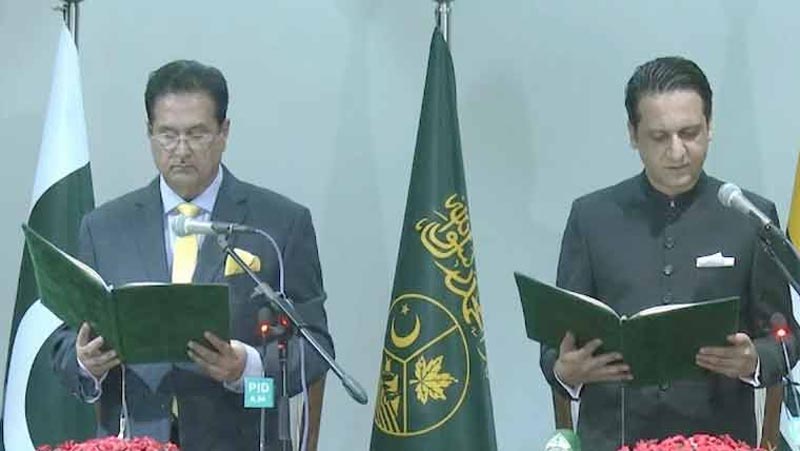
MUZAFFARABAD: Barrister Iftikhar Gilani has taken oath as the 17th Prime Minister of Azad Jammu and Kashmir after securing a majority in the Legislative Assembly.
Acting President of Azad Kashmir Chaudhry Tariq Farooq administered the oath to Gilani at a ceremony in Muzaffarabad, formally beginning his tenure as head of the AJK government.
Gilani was elected prime minister earlier after receiving 30 votes in the Legislative Assembly, while Pakistan Peoples Party candidate Sardar Mukhtar Ahmed Khan Abbasi secured 14 votes.
Following the oath-taking, Gilani thanked Prime Minister Shehbaz Sharif, PML-N leader Nawaz Sharif, Punjab Chief Minister Maryam Nawaz and other party leaders for expressing confidence in him.
He called for cooperation among members of the Legislative Assembly, saying collective efforts would be needed to make Azad Kashmir an example of development and prosperity.
Who is Iftikhar Gilani?
Iftikhar Gilani is a senior PML-N politician in Azad Kashmir who has previously served as the region’s education minister.
He first entered the AJK Legislative Assembly in 2011. In the recent elections, Gilani was elected on a PML-N ticket through a technocrat seat.
His selection as prime minister followed consultations within the PML-N over the formation of the new AJK government. The party subsequently finalized Gilani as its candidate for the top constitutional office.
His election now places him at the head of the new administration at a time when the AJK Assembly’s composition is not yet complete, with elections still pending on seven seats.
What are Iftikhar Gilani’s priorities for Azad Kashmir?
In his initial remarks as prime minister, Gilani identified inflation, employment and the future of young people among the key challenges facing Azad Kashmir.
He said the government would need to expand employment opportunities and adapt to changing job markets through digital systems, new technology and modern working methods.
Education and healthcare are also among the areas he highlighted. Gilani said further reforms would be introduced in the education sector and efforts would be made to improve healthcare services so that people would not have to travel to other cities for treatment.
He also identified agriculture, livestock and tourism as important sectors for Azad Kashmir and said these areas would be developed further.
On governance, Gilani emphasized transparency in government appointments and said the merit-based system would be taken forward. He also spoke about modernizing administrative practices, including the patwari and police-station systems, so that citizens would not need personal recommendations to access government services.
Gilani said the shortcomings in the government system would have to be identified and addressed, adding that he would remain focused on improving the administration.
Kashmir issue remains central to Gilani’s message
Speaking to reporters after taking oath, Gilani also outlined his position on the Kashmir dispute.
He said the Kashmir issue was not simply a matter of territory and maintained that it would remain unresolved until India implements the relevant United Nations resolutions.
Gilani condemned India’s actions in occupied Jammu and Kashmir and referred to the measures taken on August 5, 2019. He also paid tribute to the people of occupied Kashmir and reiterated the importance of Pakistan’s support for the Kashmir cause.
He praised Pakistan’s armed forces and thanked the country’s political leadership, including Prime Minister Shehbaz Sharif.
Seven AJK Assembly seats remain vacant
Gilani’s election comes as the formation of the new AJK government continues. Elections are still pending on seven seats of the Legislative Assembly.
The PML-N has 32 members in the assembly, while the PPP has 14, according to the figures available following the recent elections. The prime minister’s election was contested by 44 members, with Gilani securing 30 votes against 14 for the PPP candidate.
The new prime minister said his cabinet would be formed within a few days. His administration will now face the task of addressing the issues he has identified, particularly inflation, employment, public services and development, while working to complete the government’s institutional setup.