

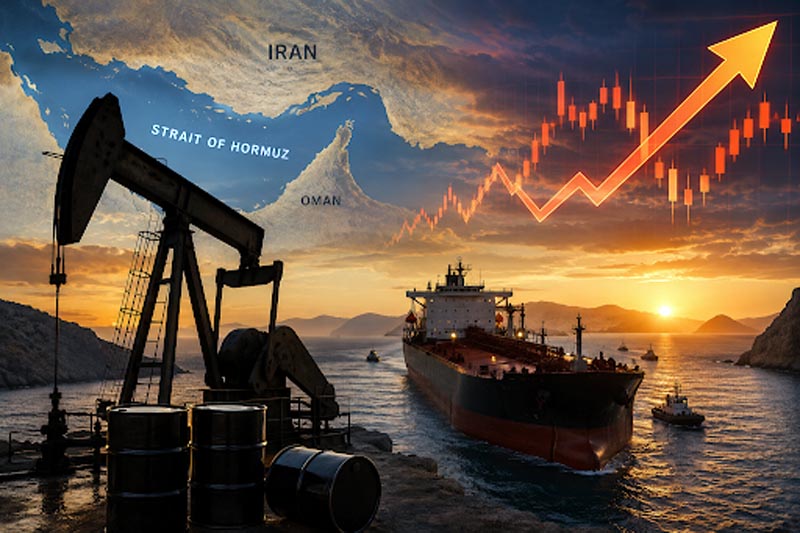
NEW YORK: Crude oil prices remained near a three-week high on Wednesday as uncertainty over shipping through the Strait of Hormuz continued to raise concerns about global energy supplies.
Brent crude was trading at around $91.20 a barrel, while US West Texas Intermediate (WTI) stood at about $85.10. Both benchmarks had earlier reached their highest levels since late July before retreating slightly.
The market remains focused on the Strait of Hormuz, where commercial shipping has fallen sharply amid uncertainty over the conditions for safe passage. Kpler data showed that only six commodity vessels crossed the waterway on Tuesday, compared with a recent 10-day average of 11 daily transits.
Why the Strait of Hormuz Matters to Oil Markets
The Strait of Hormuz is a critical energy route that previously carried about one-fifth of global oil and liquefied natural gas shipments. Disruption to the waterway therefore creates concerns about the movement of energy supplies and can add a geopolitical risk premium to oil prices.
Shipping companies have remained cautious despite conflicting statements about the status of the waterway. US President Donald Trump has said the Strait is open, while Iran maintains that it remains closed to shipping. Commercial traffic, however, continues to operate at levels well below normal.
Read More: Iran-US Conflict Shakes Global Oil Markets
US-Iran Tensions Keep Oil Markets Uncertain
The oil market is closely watching developments between Washington and Tehran. Reuters reported that a temporary ceasefire agreement expired on Monday, while Trump said on Tuesday that no talks were taking place with Iran.
The uncertainty has kept traders focused on the possibility of further disruption to maritime traffic and energy supplies. Analysts cited by Reuters said the continued lack of confidence over safe passage was keeping a geopolitical risk premium embedded in oil prices.
Oil had already climbed to a three-week high on Tuesday as hopes for progress toward a US-Iran agreement faded. Brent settled at $91.02 a barrel, while WTI settled at $84.94.
Higher Oil Prices Could Add Pressure on Consumers
Higher crude prices can increase costs across fuel markets, affecting motorists, businesses and industries that depend on transportation.
The development also creates a political challenge for the Trump administration ahead of the US midterm elections because sustained increases in fuel costs can add to pressure on household budgets.
However, the direction of oil prices will depend on several factors, including developments around Hormuz, broader geopolitical tensions and other disruptions to global supply. Reuters also reported disruptions affecting Russian oil exports from the western ports, while Iraq is preparing additional mechanisms to diversify crude export routes.
What Could Happen to Oil Prices Next?
A sustained return of commercial shipping through the Strait of Hormuz could ease concerns over supply and reduce some of the geopolitical premium currently reflected in crude prices.
On the other hand, continued disruption or further escalation could keep oil prices elevated. Analysts cited by Reuters said Brent could potentially return to three-digit levels if the risks surrounding the waterway persist, although this remains a market scenario rather than a confirmed forecast.
For now, investors are watching whether maritime traffic through Hormuz can return toward normal levels and whether diplomatic efforts can reduce the risks surrounding the region.