
ISLAMABAD: Pakistan on Thursday expressed concern over the change in the flow of Chenab River and said that a letter has been written to India seeking clarification on the matter.
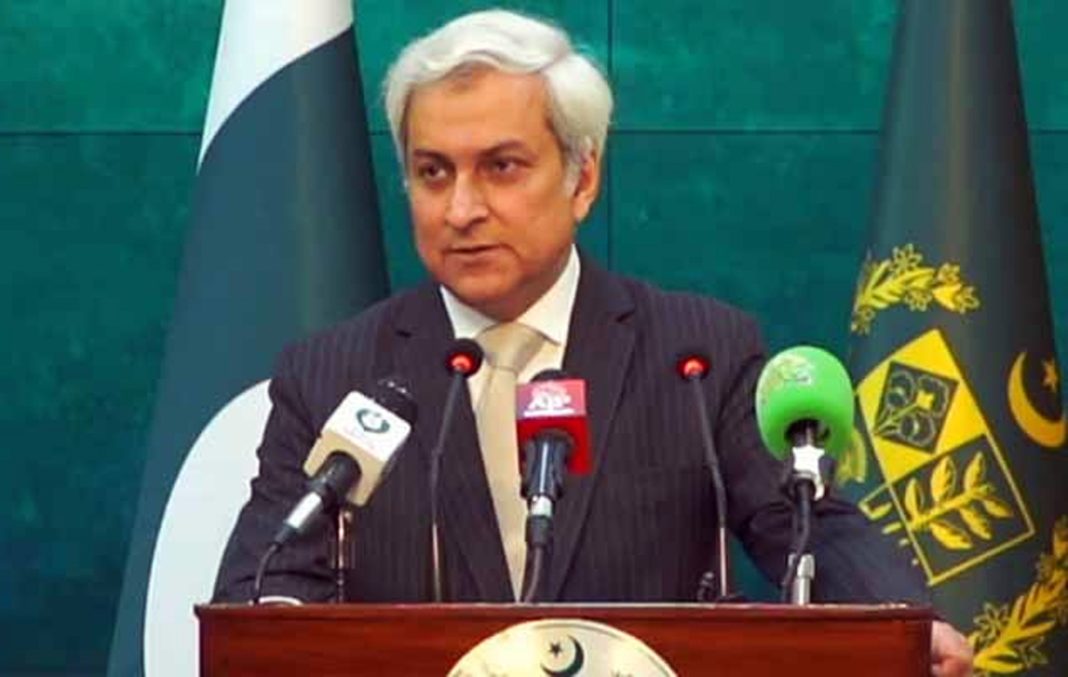
In a weekly press briefing, Foreign Office spokesperson Tahir Hussain Andrabi referred to the ‘sudden change’ in the flow of Chenab River and said that the matter has been in the news for the past one week.
Several media outlets have reported this week that India has released water into Chenab River.
The spokesperson said, “Pakistan views these changes with utmost concern and seriousness, as they indicate unilateral release of water into the Chenab River by India without prior notice.”
He said, “Our Indus Water Commissioner has written to his Indian counterpart seeking clarification as per the procedure laid down in the Indus Waters Treaty.”
Andrabi said that any interference in the flow of the river by India, especially at a critical stage of the agricultural cycle, directly threatens the lives, livelihoods, food security and economic security of our citizens.
Read More: Istanbul talks: Positive hopes attached to the success of the talks, Foreign Office Spokesperson
Read More: PM invites Bahraini business community to invest in Pakistan
He demanded that we demand India to answer the questions raised by the Pakistani Indus Water Commissioner, refrain from any unilateral interference in the flow of the river and fulfill its obligations under the Indus Waters Treaty in word and deed.
The spokesperson said that the Indus Waters Treaty is a “binding international agreement” that has been “a source of peace, security and stability in the region.”
It should be noted that under the 1960 Indus Waters Treaty, the three west-flowing rivers Indus, Chenab and Jhelum were given to Pakistan, while India got the three eastern rivers of the Indus Waters.
Tahir Hussain Andrabi said that the violation of the treaty is a threat to the sanctity of international agreements and observance of international law and it also seriously damages regional peace, the principles of good neighborliness and the norms of relations between states.
He said that the international community should take notice of India’s continuous violation of a bilateral agreement and advise India to adopt a responsible attitude, act in accordance with international law, recognized principles and its obligations.
He added that Pakistan is committed to the peaceful resolution of disputes and issues with India, however, we will not compromise on the existential water rights of our people.
It may be recalled that in April this year, India suspended the Indus Waters Treaty after an attack on tourists in the Pahalgam region of occupied Kashmir, in which 26 people were killed. New Delhi had blamed Islamabad for the incident without evidence. Pakistan had termed any attempt to suspend its share of water under the treaty as a “declaration of war” and had made it clear that the treaty did not allow for unilateral suspension.
Later, Pakistan also asked to consider legal action, citing a violation of the 1969 Vienna Convention on the Law of Treaties.
In June, the Permanent Court of Arbitration (PCA), which provides a framework for international disputes, issued a supplementary decision on jurisdiction, stating that India cannot unilaterally suspend the Indus Waters Treaty.
The supplementary decision was issued in a 2023 case filed by Pakistan in the PCA against the design of Indian hydroelectric projects on rivers given to Pakistan under the Indus Waters Treaty.
Indian woman’s hijab-pulling incident
During the press briefing, the Foreign Office spokesperson also mentioned the incident of Bihar Chief Minister Nitish Kumar removing the hijab of a female doctor this week, which was severely criticized.
Tahir Hussain Andrabi said that after the incident, an Uttar Pradesh minister also made ‘public mockery’ of this action. The minister had earlier defended Nitish Kumar, but later retracted his statement.
He said that the act of a senior political leader forcibly removing the hijab of a Muslim woman and then making public mockery of this act is very worrying and demands strong condemnation.
The Foreign Office spokesperson said that this move risks normalising the humiliation of Muslim women in India and that this behaviour shows public contempt for India’s religious minorities, especially Muslim citizens.
He added that such behaviour reflects a broader and worrying trend linked to Hindutva-inspired politics, including an alarming rise in religious intolerance and Islamophobia.
He said that we call on all responsible parties and the Indian government to acknowledge the seriousness of this incident and reiterate their commitment to protecting the rights of minorities, respecting religious freedom and upholding human dignity.